
At Yolanda Reef off Ras Mohammed, 14 metres down, sunlight streams onto a steep coral slope. A pair of bright yellow masked butterflyfish hovers quietly beside a table coral, while a solitary rusty parrotfish scrapes algae from the substrate, leaving white beak marks on the limestone. Below them, fusiliers sheet across the drop-off in a synchronized blue flash.
Observing reef fish of the Red Sea offers an encounter with one of the most distinctive marine ecosystems on Earth. Diving conditions remain reliable year-round, though the best surface conditions occur between May and October when winds settle. Water temperatures range from 22°C in northern winter months to more than 30°C during southern summers, with underwater visibility routinely exceeding 20 to 30 metres across most offshore reefs.
Key dive locations such as Ras Mohammed National Park, Jackson Reef in the Strait of Tiran, and Elphinstone Reef feature shallow coral flats, vertical walls, and plateau structures. These habitats support species tailored to every depth level, accommodating casual snorkellers in 2-metre shallows as easily as technical divers down at 40 metres.
What Makes Reef Fish of the Red Sea Unique?
The uniqueness of Red Sea marine life stems from millions of years of geological isolation. The sea connects to the Indian Ocean solely through the Bab el-Mandeb Strait, a narrow passage measuring roughly 29 kilometres across. Surrounded by arid desert landmasses, high rates of evaporation drive ocean salinity near 40 practical salinity units, creating a warm, highly saline environment that favors specialized species.
Research published by Kochzius, Myers, Paulay and colleagues, Journal of Biogeography, 2016 documented 1,071 shallow-water fish species in the Red Sea, with 138 species (12.9%) strictly endemic to its waters. When expanding the geographic boundary to include the adjacent Gulf of Aden, the regional endemic figure rises to 189 species, or 14.1%. Studies by DiBattista and colleagues, Journal of Biogeography, 2016 further showed that repeated sea-level fluctuations isolated these populations, spurring the evolution of unique regional lineages.
This high concentration of regional species means divers routinely encounter fish found nowhere else. Water temperatures fluctuate depending on latitude and season, dipping to 22°C around Sharm El Sheikh in January while exceeding 30°C near Hamata in August. These environmental extremes shaped hardy, specialized fish communities adapted to specific thermal thresholds and hard coral habitats.
Which Butterflyfish and Angelfish Live in the Red Sea?
Butterflyfish (family Chaetodontidae) are among the most conspicuous inhabitants of shallow hard-coral gardens. Their laterally compressed, disc-like bodies allow them to maneuver between branching acropora heads, where they use narrow, protrusible snouts to pick off coral polyps and small invertebrates. The Masked Butterflyfish (Chaetodon semilarvatus), recognized by its lemon-yellow body and blue patch behind the eye, frequently hovers in stationary pairs between 5 and 20 metres depth.
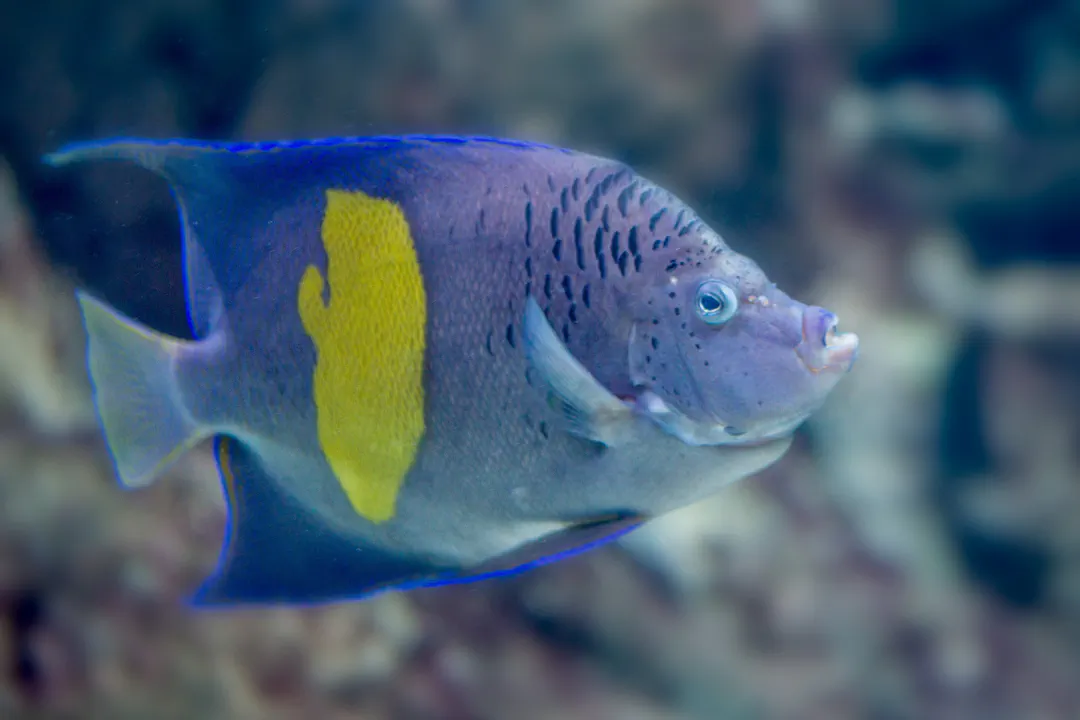
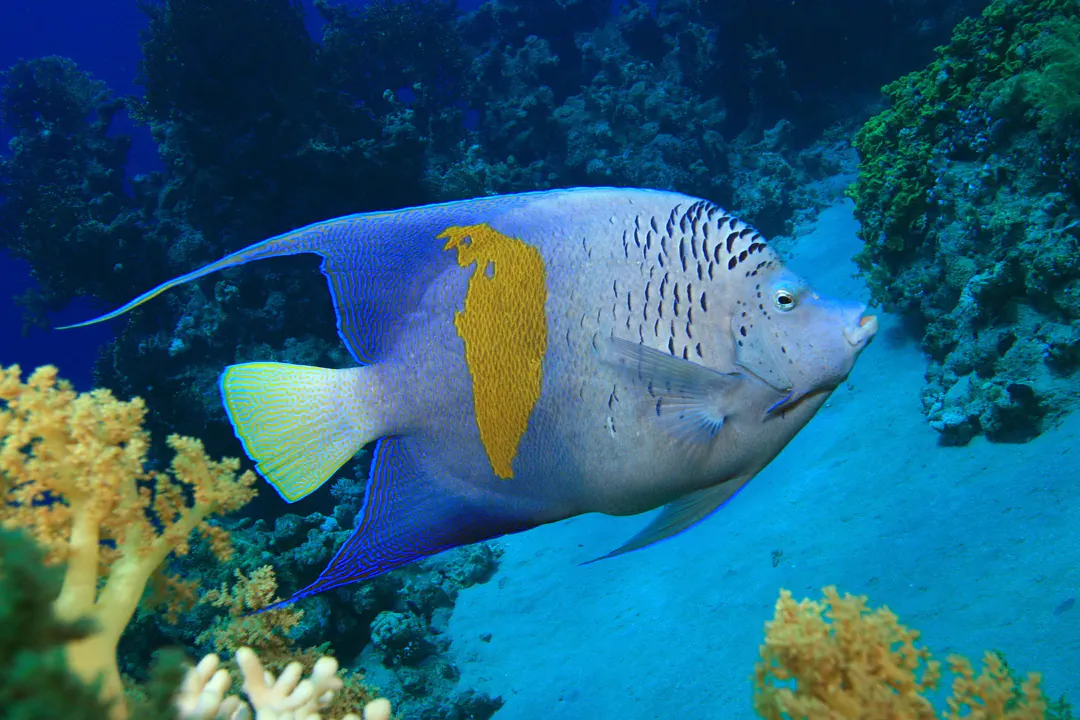
Angelfish (family Pomacanthidae) share a similar flattened silhouette but are distinguished by a sharp spine projecting from the lower edge of their gill cover. The Arabian Angelfish (Pomacanthus asfur) displays a dark midnight-blue body accented by a bright yellow tail and a crescent-shaped flank patch. It tends to frequent shaded overhangs and ledges, whereas the larger Yellowbar Angelfish (Pomacanthus maculosus) ventures across open reef slopes.
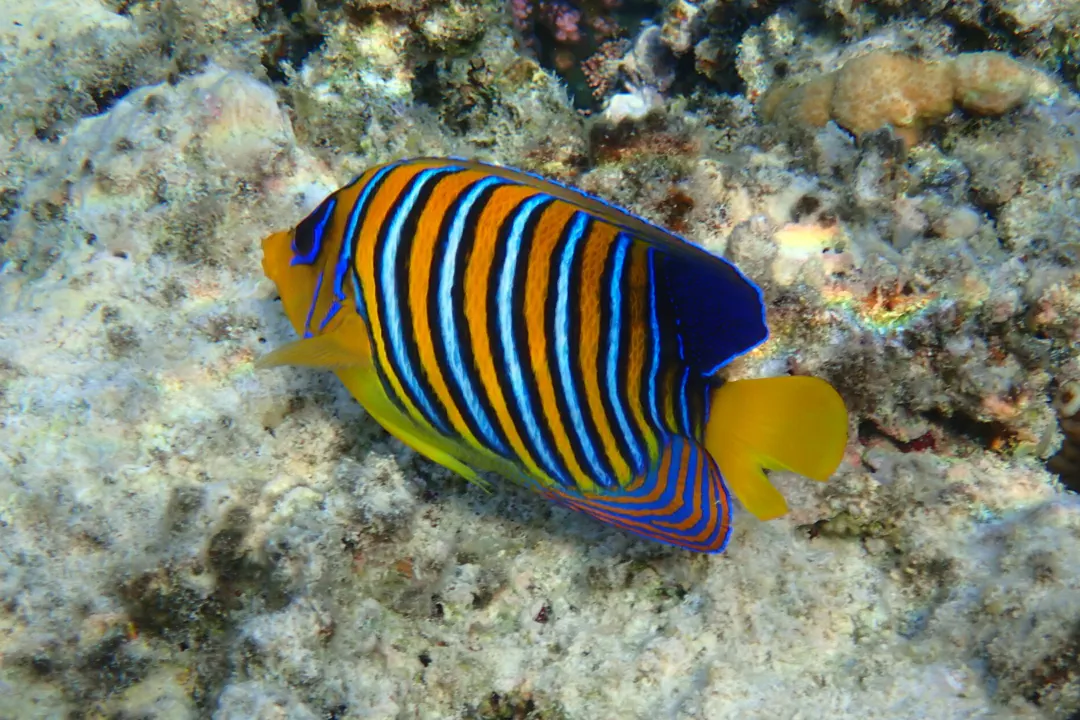
Divers also observe the Regal Angelfish (Pygoplites diacanthus) swimming along outer reef walls, its body patterned with vertical orange, white, and blue bands. Along with smaller endemics like the Crown Butterflyfish (Chaetodon paucifasciatus) and Hooded Butterflyfish (Chaetodon larvatus), these species rely heavily on structural reef complexity. As water absorbs red wavelengths below 10 metres, divers rely on body bars and facial masks rather than overall color to distinguish species.
 © seabook.appAll rights reserved
 Andrew DeaconCC0 · iNaturalist
What Wrasses and Parrotfish Inhabit Red Sea Reefs?
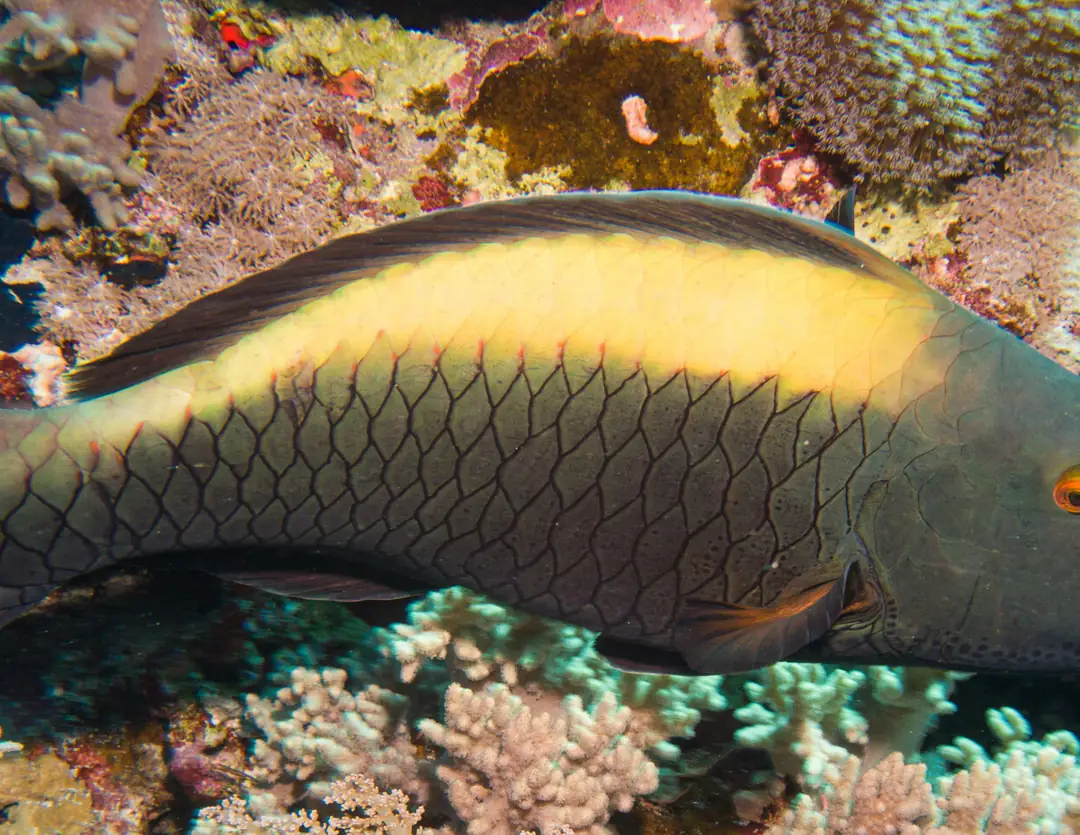
Herbivorous parrotfishes perform critical ecological work by grazing turf algae from limestone substrates. Equipped with fused beak-like teeth, species like the Rusty Parrotfish (Scarus ferrugineus) scrape bare rock, ingesting coral fragments in the process. The ingested calcium carbonate passes through their digestive systems and is excreted as fine white coral sand, reshaping local sediment dynamics across shallow reef flats.
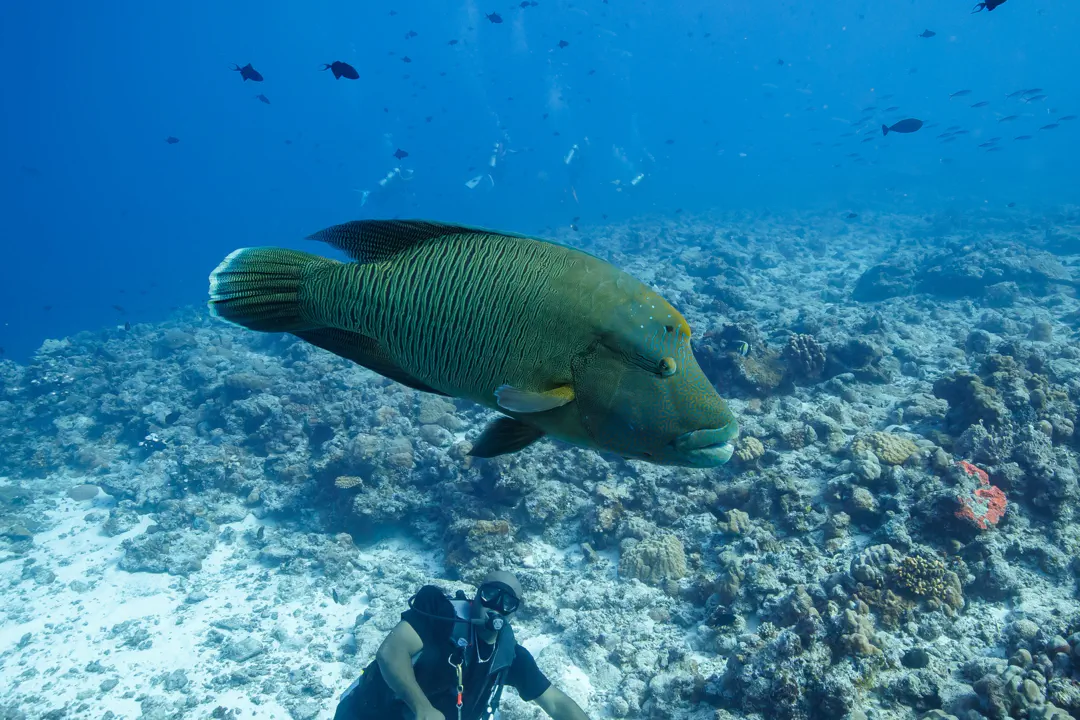
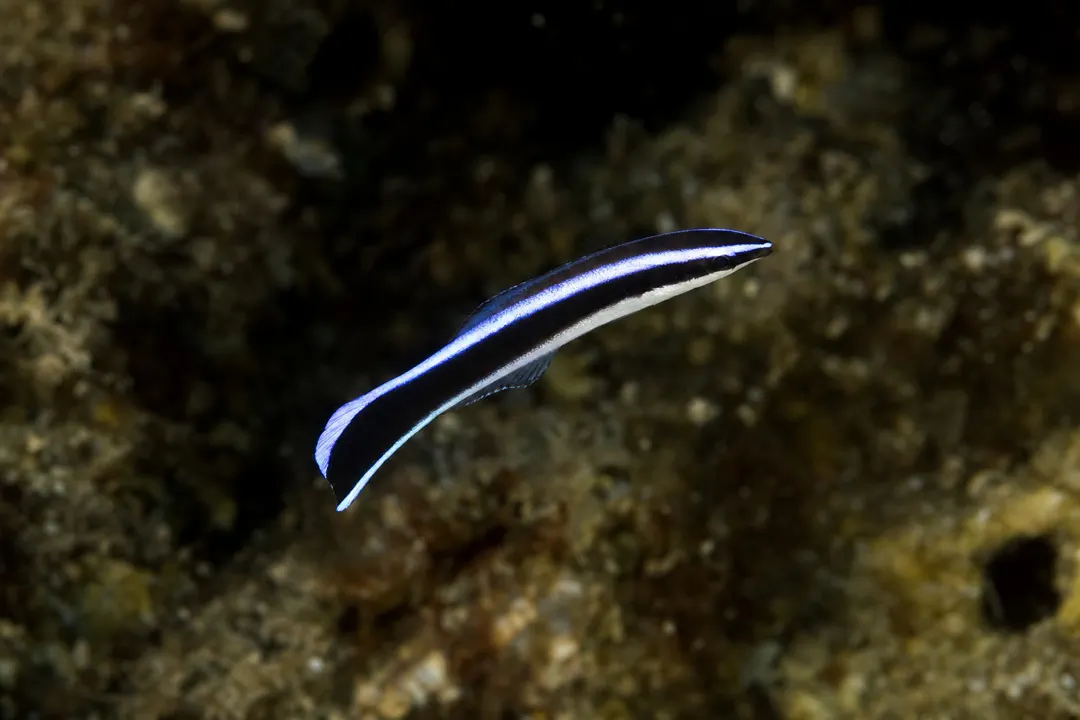
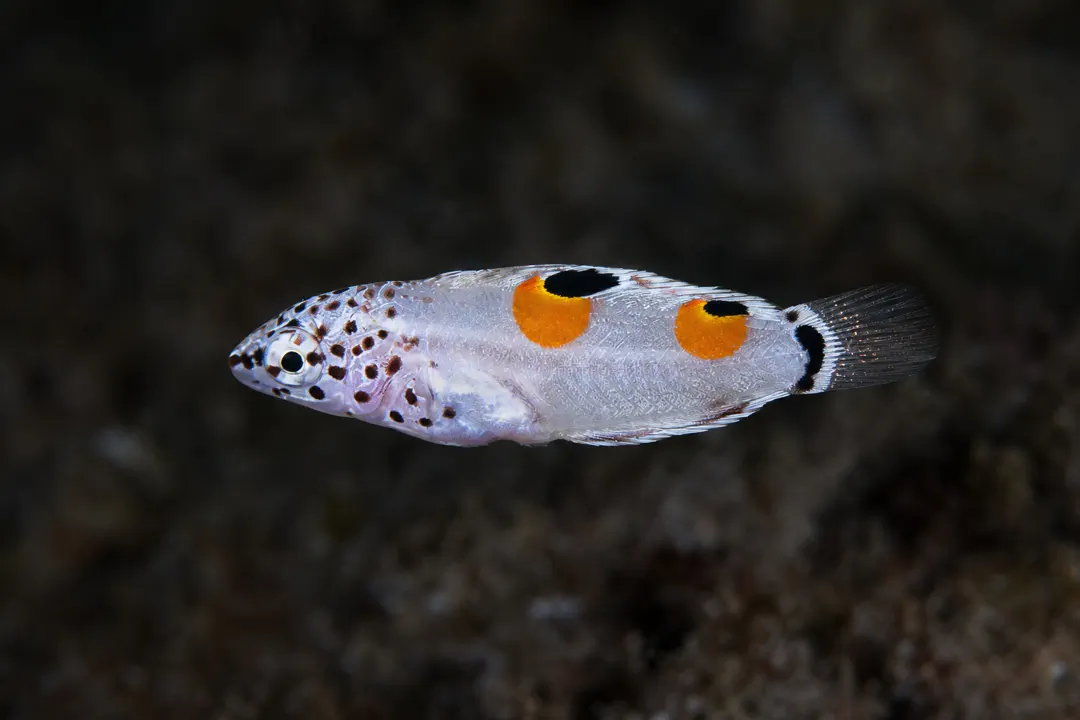
Wrasses (family Labridae) exhibit extreme variations in size, color, and behavior. The tiny Bluestreak Cleaner Wrasse (Labroides dimidiatus) establishes cleaning stations on coral heads at depths of 5 to 15 metres. Larger species, such as the Red Sea Broomtail Wrasse (Thalassoma rueppellii) and the solitary Clown Coris (Coris aygula), inspect sandy patches for buried invertebrates. The largest representative, the Napoleon Wrasse (Cheilinus undulatus), can reach lengths of two metres and weights exceeding 180 kilograms.
At cleaning stations, larger fish line up motionless, holding their fins spread and mouths open while cleaner wrasses remove parasites and dead tissue. Divers logging their sightings in the Seabook app can record these behavioral interactions alongside visual observations across shallow plateau sites. Observing these mutualistic relationships offers insight into how energetic resources move across the reef.
 © Lesley ClementsAll rights reserved
 © seabook.appAll rights reserved
 © seabook.appAll rights reserved
 © seabook.appAll rights reserved
Which Damselfishes and Anemonefish Are Found in the Red Sea?
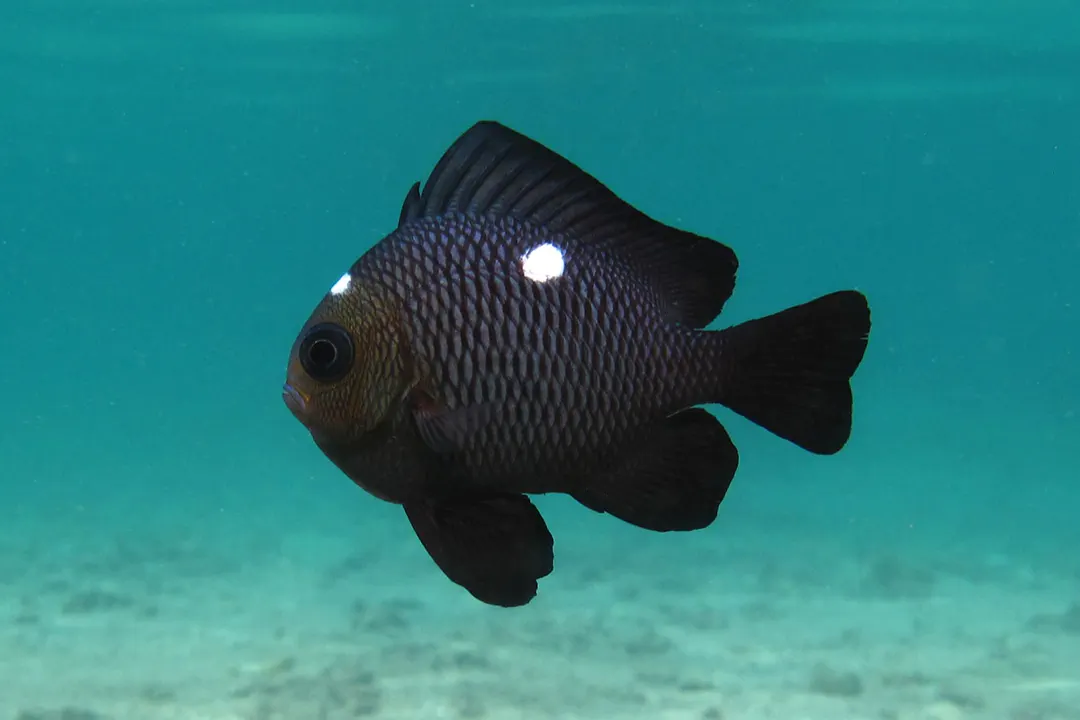
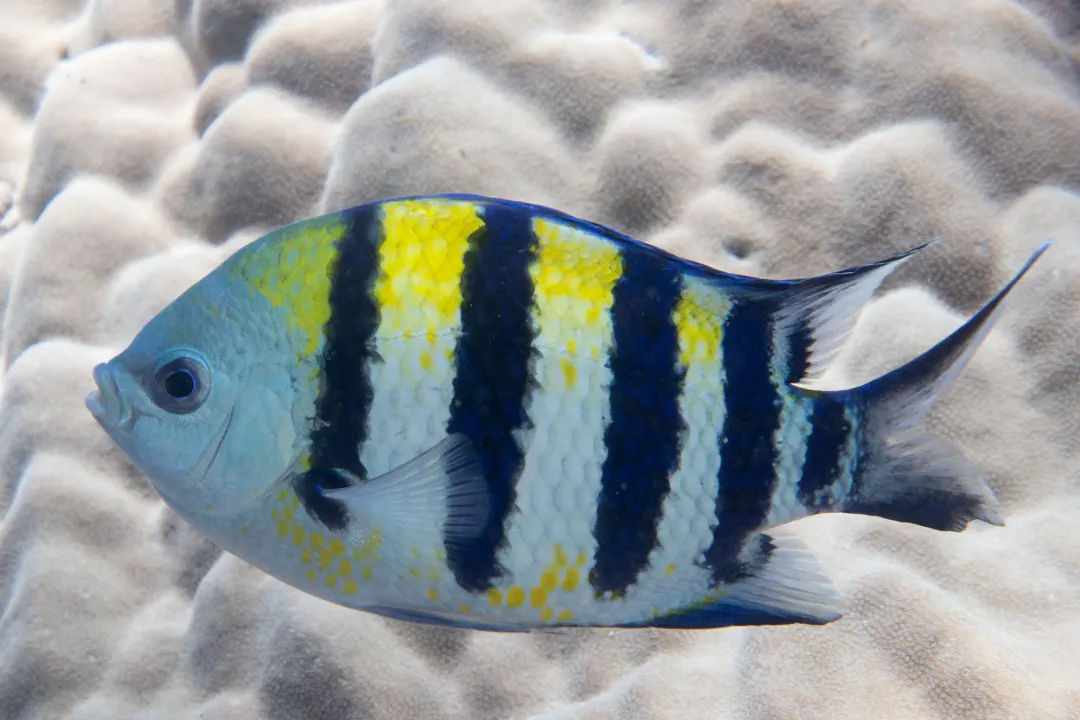
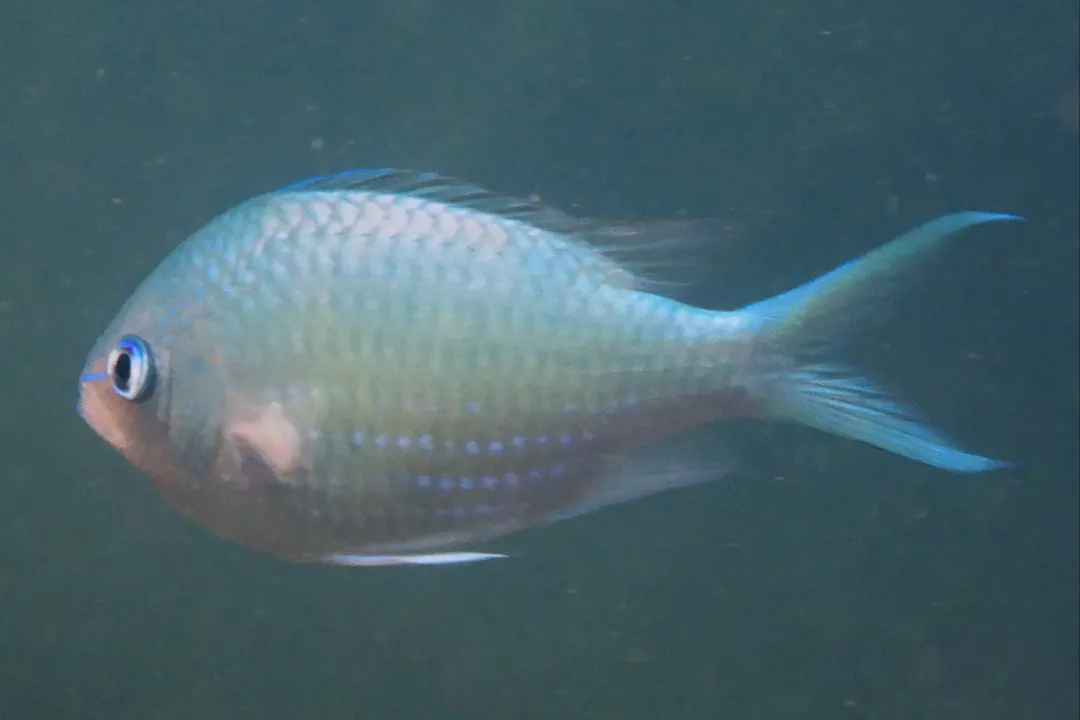
Shallow coral crests between 1 and 8 metres depth host dense colonies of damselfishes (family Pomacentridae). Species like the Blue Green Chromis (Chromis viridis) hover in clouds above branching staghorn corals, darting into the tight maze of branches at the slightest shadow. The Domino Damselfish (Dascyllus trimaculatus) and Marginate Dascyllus (Dascyllus marginatus) maintain small, fiercely guarded feeding spaces over individual coral heads.
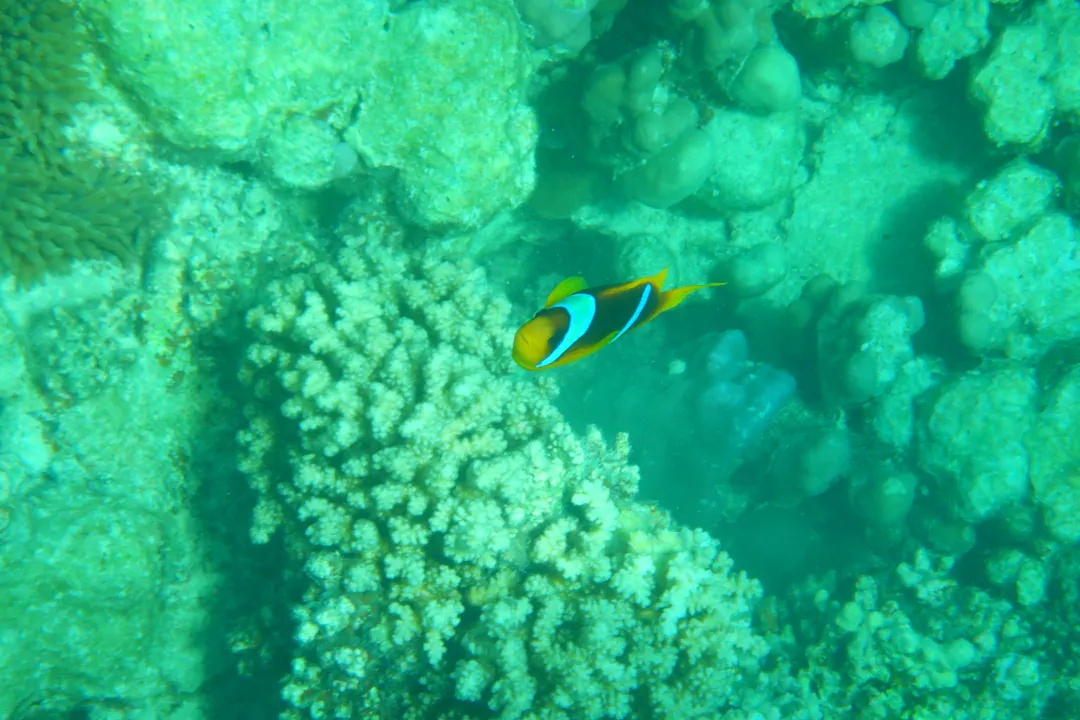
The Red Sea Anemonefish (Amphiprion bicinctus) lives in a symbiotic relationship with large sea anemones, primarily Entacmaea quadricolor and Heteractis magnifica. Featuring two white vertical bars against an orange-brown body, this fish secretes a protective mucus layer that prevents the host anemone's stinging nematocysts from firing. The anemone provides shelter from predators, while the fish defends the host against polyp-eating species.
Breeding pairs of anemonefish rarely stray more than a few metres from their host tentacles. Female anemonefish lay eggs on cleaned rock surfaces right at the base of the anemone, while smaller males continuously fan the eggs with their pectoral fins to keep them oxygenated. Snorkellers and divers can observe these nesting behaviors in shallow water without disturbing the territory.
 © Gergely NiggCC BY 4.0 · iNaturalist
 © Valued imageCC BY-SA 4.0 · iNaturalist
 © Rickard ZerpeCC BY 4.0 · iNaturalist
 © Ewout KnoesterCC BY-SA 4.0 · iNaturalist
What Surgeonfish and Triggerfish Swim in the Red Sea?
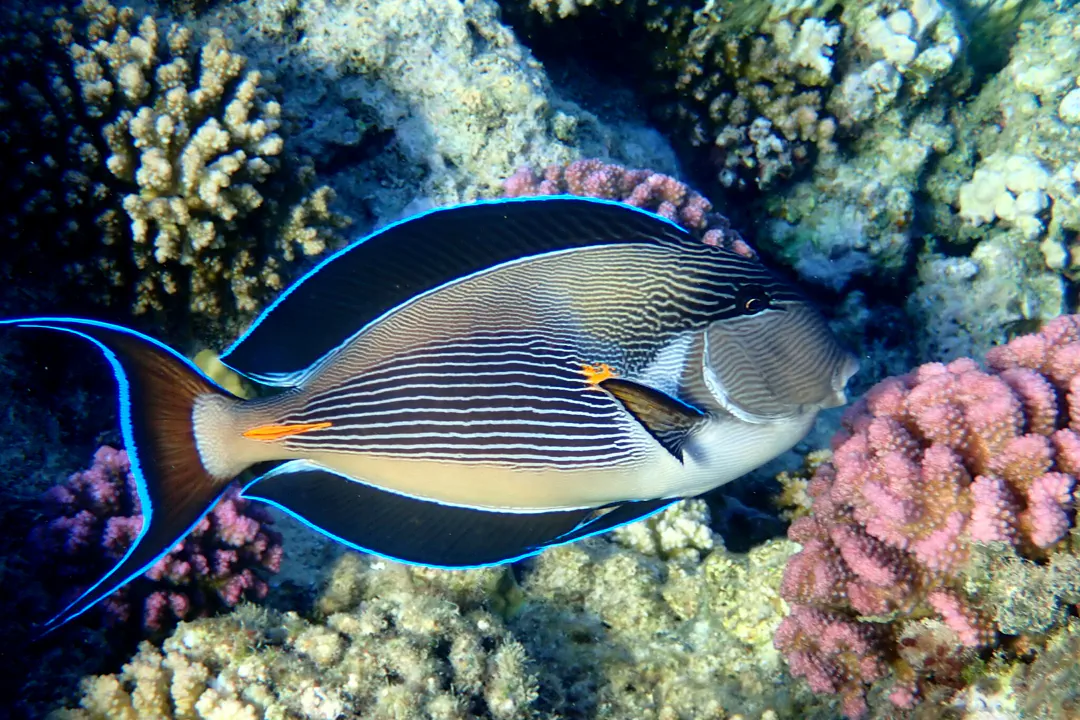
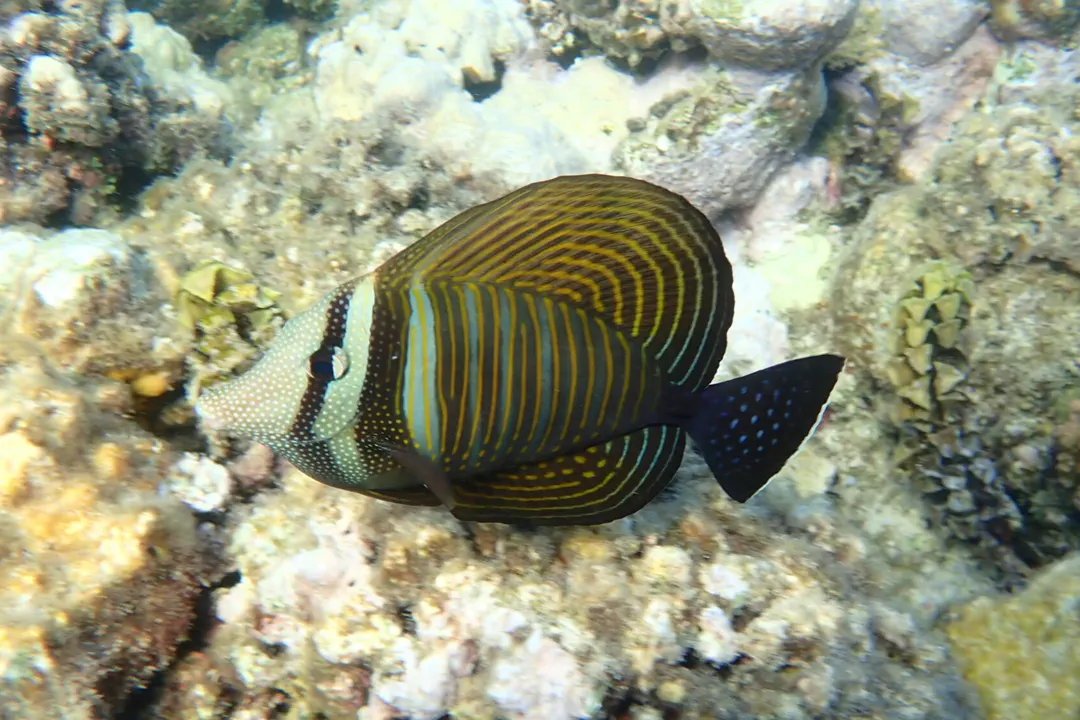
Surgeonfishes (family Acanthuridae) carry sharp, spine-like blades on each side of the tail base, used for defense and territorial disputes. The Sohal Surgeonfish (Acanthurus sohal) features fine horizontal blue stripes and a bright orange spine casing. It patrols shallow reef margins between 1 and 10 metres, aggressively chasing away competing herbivores to guard its personal patch of filament algae.
Other common surgeonfishes include the Purple Tang (Zebrasoma xanthurum), noted for its deep violet body and yellow pectoral fins, and the Desjardin's Sailfin Tang (Zebrasoma desjardinii). Triggerfishes (family Balistidae) rely on a different set of physical adaptations, using strong, beak-like jaws to break open sea urchins, crabs, and mollusks along sandy substrate.
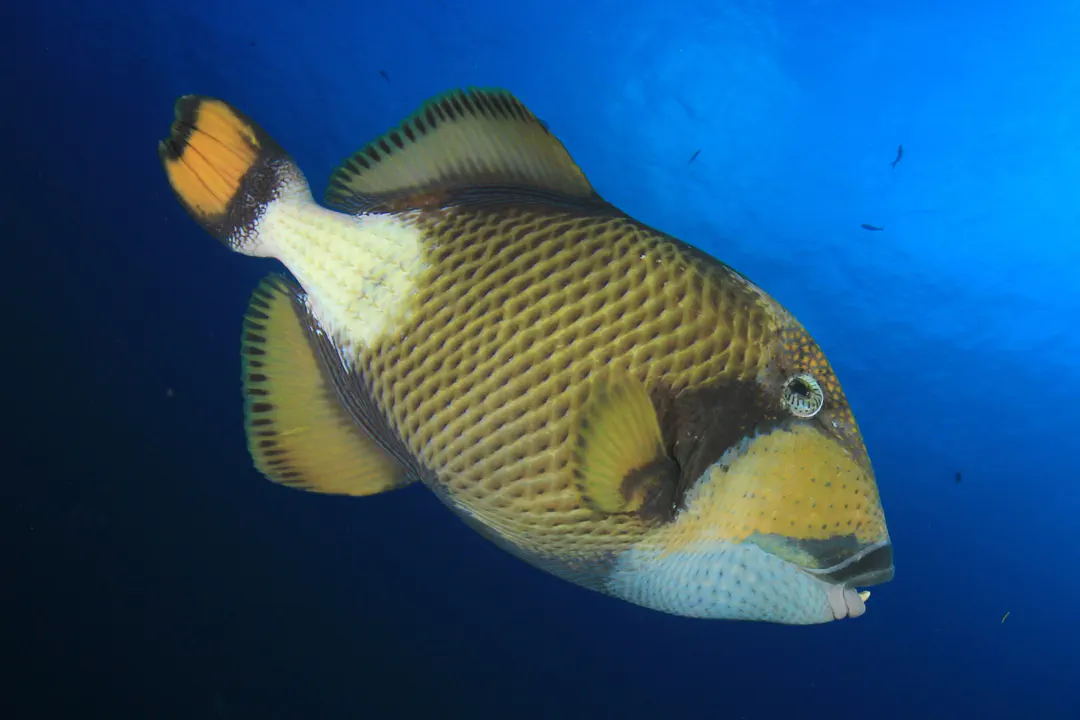
The Titan Triggerfish (Balistoides viridescens) grows up to 75 centimetres long and constructs shallow crater nests in sand or coral rubble. During nesting periods, females aggressively defend a cone-shaped airspace extending from the nest upward to the surface. Divers encountering a defensive triggerfish should swim horizontally away from the nest site rather than ascending, as ascending stays within their cone of defense.
 Andrew DeaconCC0 · iNaturalist
 Andrew DeaconCC0 · iNaturalist
 © seabook.appAll rights reserved
Which Predatory Reef Fish Live in the Red Sea?
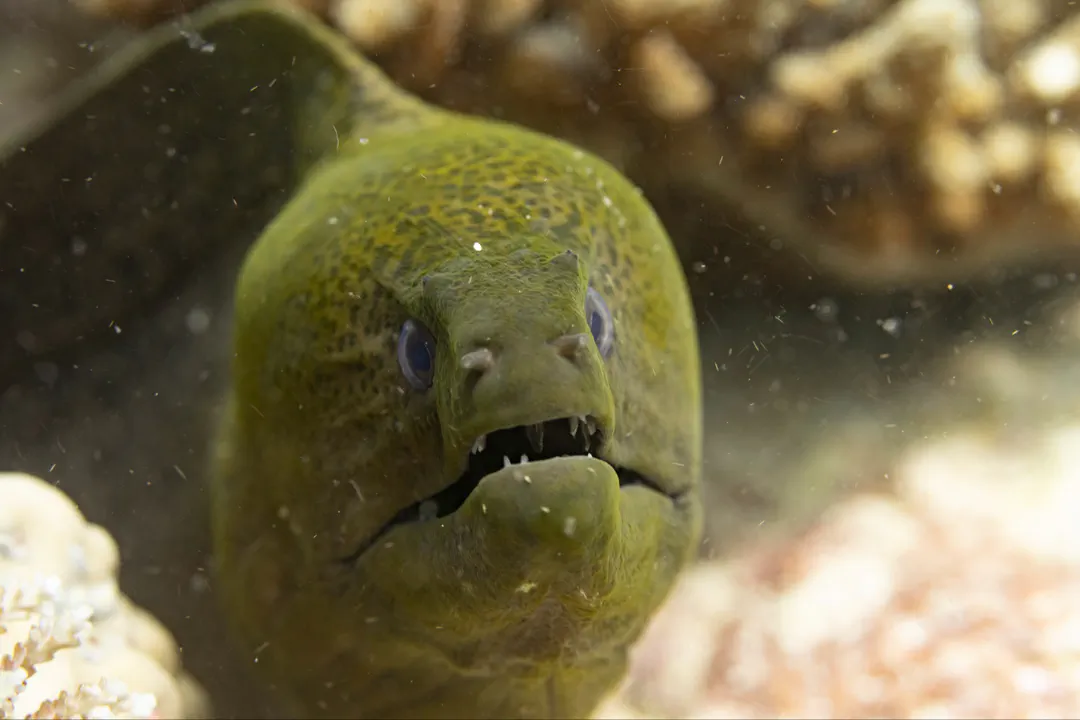
Predatory reef fish occupy deep wall drop-offs, caves, and overhangs starting around 12 metres down. The Giant Moray Eel (Gymnothorax javanicus) rests inside rock crevices during daylight hours, opening and closing its mouth to move water across its gills. Reaching lengths up to three metres, these muscular predators leave their shelters at dusk to hunt sleeping reef fish along the seabed.
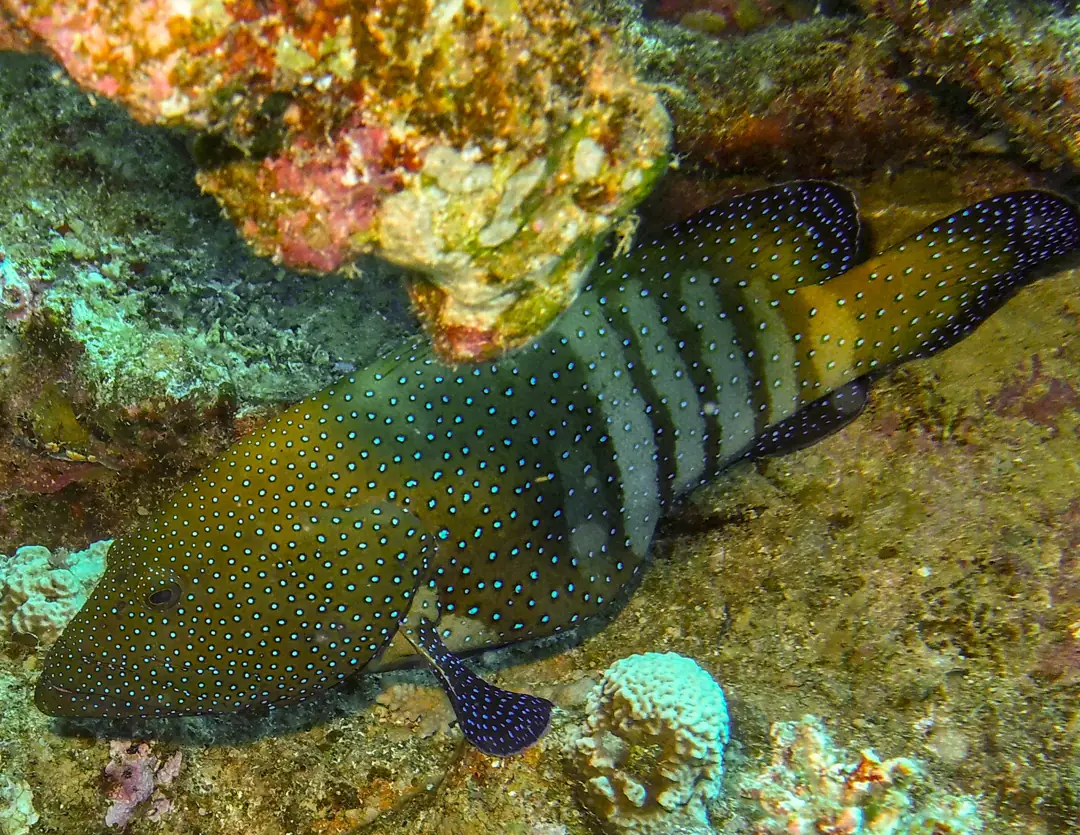
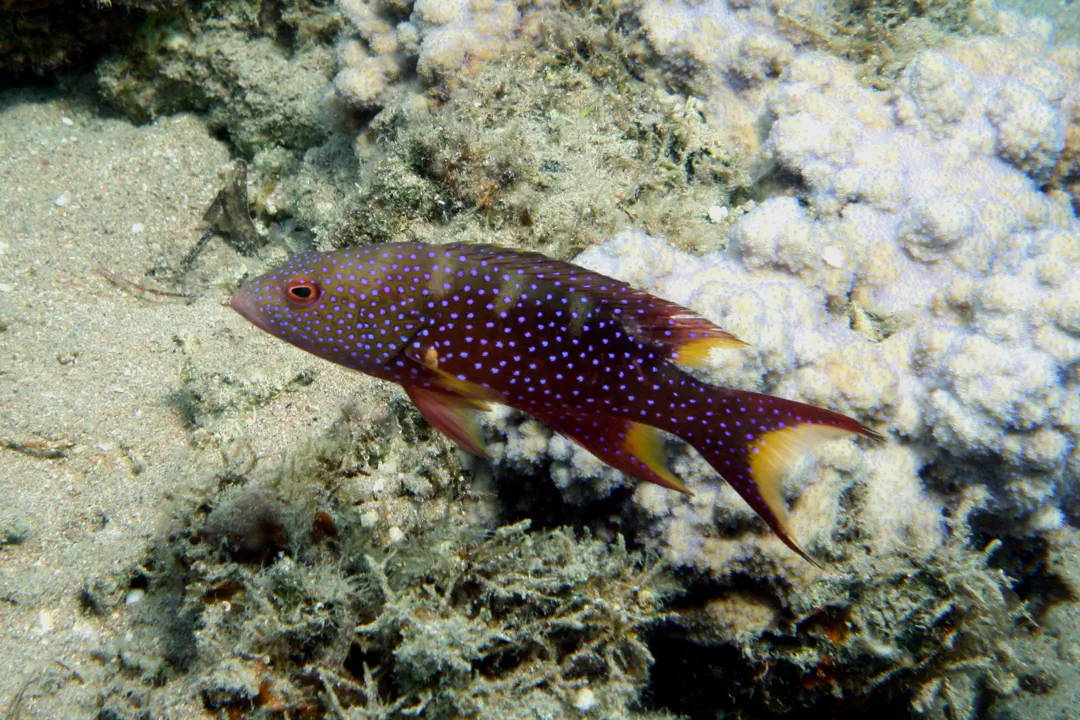
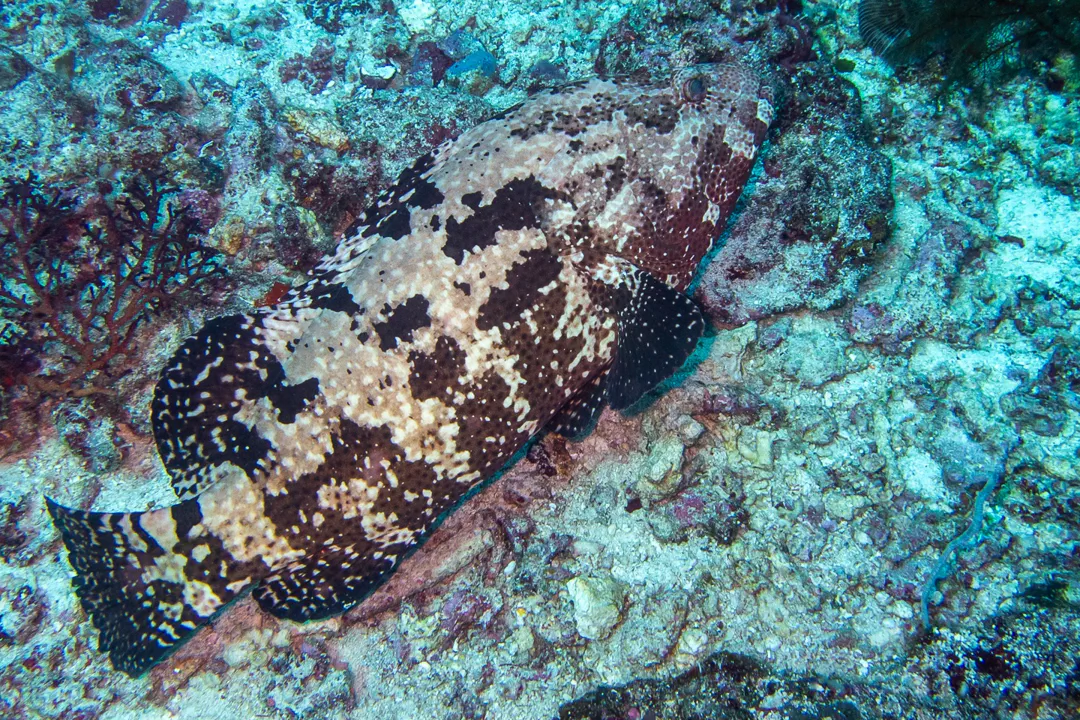
Groupers (family Serranidae) serve as apex ambush predators across coral slopes. The Red Sea Coral Grouper (Variola louti), easily identified by its crescent-shaped tail and yellow fin margins, hunts small fish around structural coral ledges. Nearby, Peacock Groupers (Cephalopholis argus) maintain ambush positions in dim reef recesses, relying on dark blue body spots for camouflage.
The Devil Firefish (Pterois miles), a native Red Sea lionfish, uses broad pectoral fins to corner prey against vertical rock walls. Armed with venomous dorsal spines, it hunts small cardinalfish and wrasses in low-light conditions. Divers should maintain neutral buoyancy and keep distance from overhangs where lionfish hover upside down along cave ceilings.
 © Lesley ClementsAll rights reserved
 © Chris ChuchollCC BY 4.0 · iNaturalist
 © cello caruso-turielloCC BY 4.0 · iNaturalist
 © Piotr LukasikCC BY 4.0 · iNaturalist
How Do You Identify Reef Fish of the Red Sea?
Accurate fish identification underwater relies on a four-part process: body shape, fin placement, eye or facial markings, and observed behavior. Silhouette is the fastest indicator of family. A deep, laterally compressed body points to butterflyfish or angelfish, while an elongated body with continuous dorsal fins suggests a wrasse or grouper.
Because seawater absorbs red wavelengths of light below 5 metres, relying entirely on color leads to frequent misidentifications. Divers should look for structural patterns such as vertical bars, tail shapes, or distinctive masks. Noting whether a fish grazes algae, hovers in stationary pairs, or stays tucked inside an anemone quickly narrows species choices.
Recording depth and micro-habitat provides final identification clues. Note whether the subject was swimming over a 3-metre sand flat or along a 30-metre vertical drop-off. Maintaining good buoyancy control keeps fins off the reef, protecting fragile hard coral habitats while allowing close, non-disruptive observations.
Questions
What is the most famous endemic fish in the Red Sea?
The Masked Butterflyfish (Chaetodon semilarvatus) is widely regarded as an iconic endemic species of the Red Sea region. Recognizable by its bright yellow disc-like body and dark blue facial patch, it is commonly observed swimming in pairs around hard coral gardens between depths of 5 and 20 metres.
Are there dangerous reef fish in the Red Sea?
A few species possess defensive adaptations that require care from divers. Lionfish (Pterois miles) and stonefish carry venomous spines along their fins, while nesting Titan Triggerfish (Balistoides viridescens) aggressively defend their territory. Maintaining neutral buoyancy and keeping hands off reef surfaces prevents accidental encounters.
Why are Red Sea fish so colorful?
Vibrant coloration serves key survival functions in coral reef habitats, including species recognition, mate selection, and territorial signaling. Distinct patterns also act as disruptive camouflage against intricate coral backgrounds or signal unpalatability and toxicity to potential predators.
Can snorkellers see these reef fish in the Red Sea?
Yes, many prominent Red Sea fish species inhabit shallow reef flats between 1 and 5 metres depth. Snorkellers regularly see Red Sea anemonefish, parrotfish, surgeonfish, butterflyfish, and damselfishes right off shore or directly from day-boat moorings.
What fish species are unique to the Red Sea?
Regionally restricted species include the Masked Butterflyfish, Red Sea Anemonefish, Crown Butterflyfish, Arabian Angelfish, and the Assasi Triggerfish. Research indicates approximately 12.9% to 14.1% of shallow-water fish species in the Red Sea and Gulf of Aden live nowhere else.
How many fish species live in the Red Sea?
Scientific reviews record over 1,071 shallow-water fish species in the Red Sea proper. Including deep-water habitats and broad regional inventories brings the total count to more than 1,200 recorded marine fish species.

